
Oral History
Oral history interview with Ray Albright, 2009

- Title
- Oral history interview with Ray Albright, 2009
- Description
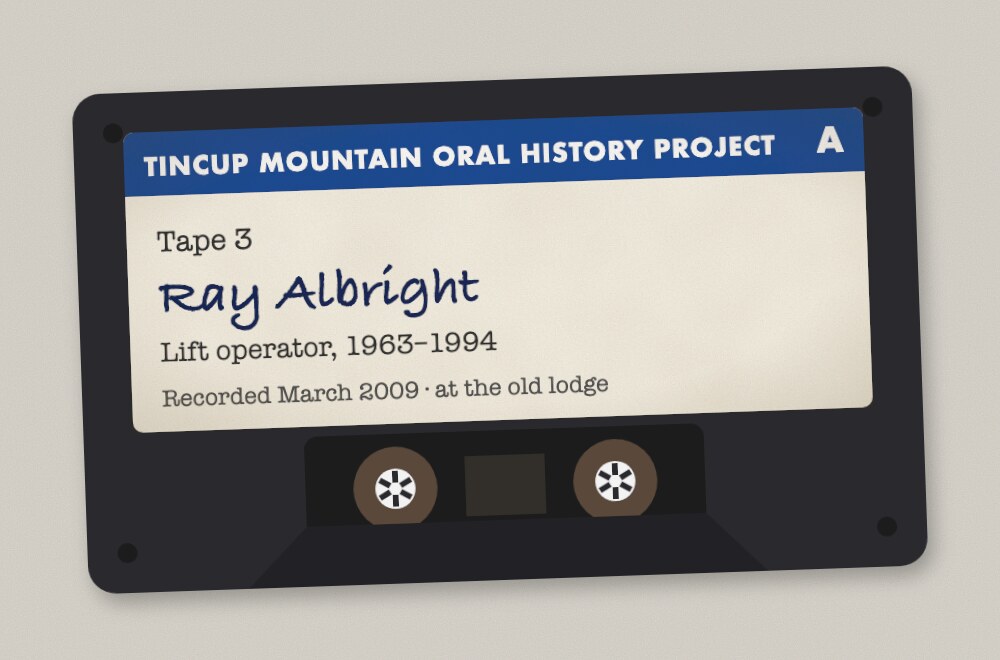
- Recorded in the empty lodge, Ray Albright describes loading the first chair on the Silver Spoon in 1963, keeping it running through the Big Winter of 1984–85, and turning the key on the last day in 1994.
- The recording here is an edited four-minute excerpt with synthetic voices, generated for this demo with ElevenLabs text to speech.
- Date
- 2009-03-14
- Rights
- Fictional demonstration content created for the Omeka S demo. Free to reuse (CC0 1.0).
- Subject
- Oral histories
- Chairlifts
- Ski resorts--Closures
- Interviewer
- Ellen Marsh, Harlow Public Library (fictional)
- Interviewee
-
 Ray Albright
- Location
- The former Tincup Lodge, Tincup Mountain
- Transcription
-
MARSH: And the last day.
ALBRIGHT: That last afternoon I loaded every chair myself. People I'd been loading for thirty years, and their kids, and some of their grandkids. Dot Kimura came through, and Lena Ruiz from the patrol, and the mayor's daughter, the first mayor's, who wasn't a little girl anymore. At four o'clock I sent the last chair up empty, the way we always did at closing, and when it came around I rode it down. Then I turned the key. It was very quiet after that. - Original Format
- Audio cassette (Tape 3, side A)
- Duration
- 3 minutes 56 seconds (edited excerpt)
- Time Summary
- 00:00 Walking through the lodge
- 00:52 Hired at twenty-one; the first chair, December 14, 1963
- 01:48 Rebuilding the bullwheel, 1971 and 1986
- 02:34 The Big Winter: digging out the chairs every morning
- 03:11 March 27, 1994: the last chair
- Site pages
- Voices
Interview audio, Tape 3 side A (synthetic voices)
Transcript — follows along as audio plays
This is Ellen Marsh with the Tin Cup Mountain Oral History Project. It's March 14, 2009. I'm with Ray Albright, and we're inside the old Tin Cup Lodge, which has been closed for, what, 15 years now?
Fifteen years this month.
Watch your step there. The floor's gone soft by the door. They've got the windows boarded up, but you can still see where the ski racks were, right along that wall.
What was this room like on a Saturday?
Loud. Loud and wet. 300 people in ski boots, and every one of them dripping. Ingrid's cinnamon rolls coming out of the kitchen right over there. And the windows all steamed up, so you couldn't even see the hill. You'd come in at noon, and you couldn't find your own family.
How did you start working here?
I was 21. I'd been pumping gas at my dad's station, and the lodge company needed men for the new chairlift, the Silver Spoon. I didn't know a thing about chairlifts. Neither did anybody else. We learned it out of a manual from the company in Denver, and from a fella they sent out for two weeks.
And you loaded the first chair.
December 14, 1963. They had the high school band out there in the snow, and the mayor cut a ribbon on the ramp. And I was so nervous, my hands were shaking. First two up were the mayor and his wife. I swung that chair around, and she grabbed my arm and said, “Young man, are you sure this thing works?” And I said, “Yes, ma'am.” And I was not sure at all.
You kept that lift running for 30 years.
30 and a half. You get to know a machine. The Silver Spoon had a sound, kind of a hum when everything was right, and a different hum when something wasn't. In 1971, the bull wheel bearing started going, and I heard it a week before anything showed. We rebuilt the whole bull wheel that summer. Did it again in '86. Both times, I had my hands in that thing up to the elbows.
Did people know how much work went into it?
No, and that's how it should be. If you did your job right, nobody thought about the lift at all. They just thought about the snow.
Tell me about the big winter.
'84, '85. 412 inches. Every morning we'd come up before it was light, and the chairs would be buried, just the backs sticking up out of the snow like a row of headstones. We dug out every one of them by hand, 60-some chairs. Then you'd run the lift empty for an hour to shake the ice off the cable. Some mornings it snowed so hard, we were digging out the first chairs again before we'd got to the last ones.
And the last day.
That last afternoon, I loaded every chair myself. People I'd been loading for 30 years, and their kids, and some of their grandkids. Dot Kimura came through, and Lena Ruiz from the patrol, and the mayor's daughter—the first mayor's—who wasn't a little girl anymore. At 4 o'clock, I sent the last chair up empty, the way we always did at closing. And when it came around, I wrote it down. Then I turned the key. It was very quiet after that.
Thank you, Ray.
Well, somebody ought to remember it.